
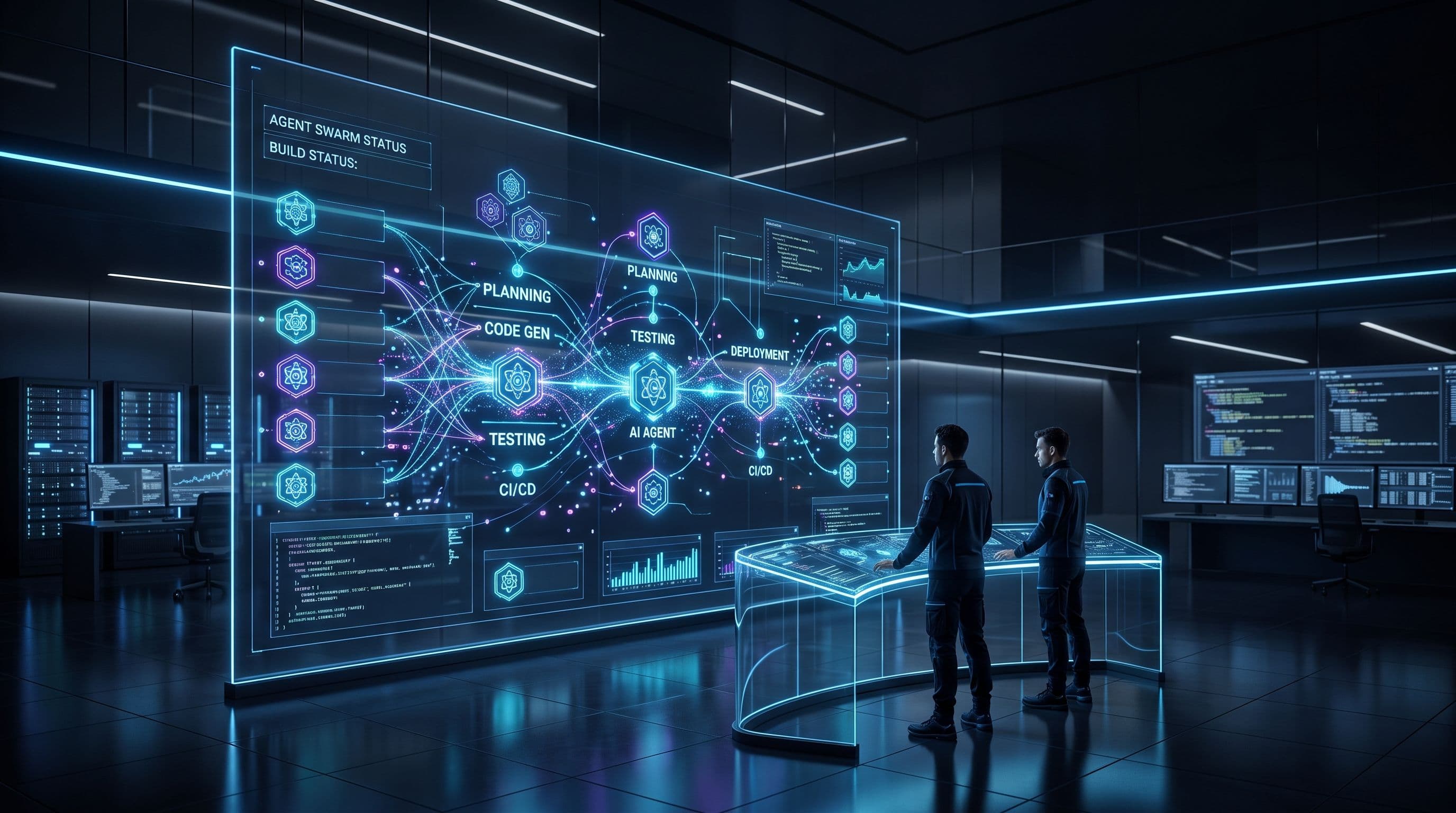
Agent-Driven Engineering: AI Is Not Just Changing How We Code. It Is Changing How We Run Engineering.
For the last decade, the operating model of software engineering was relatively predictable. When organizations needed more output, they hired more developers, created additional squads, and optimized their agile delivery processes.
That model is beginning to change.
AI coding assistants are evolving into agents that can interpret requirements, propose technical designs, modify repositories, execute tests, and prepare changes for human approval. Orchestration platforms can connect these agents to development workflows, enterprise systems, and operational processes.
This is more than another productivity tool.
Agentic engineering changes the production system of software. It affects how work enters an engineering organization, how decisions are made, how quality is assured, how costs are controlled, and how accountability is assigned.
The leadership challenge is therefore not simply to deploy more AI tools. It is to redesign engineering so that humans and agents can create validated business outcomes without compromising security, architectural integrity, or long-term organizational capability.
Faster Coding Is Not the Same as Faster Delivery
The first wave of AI adoption has focused heavily on developer productivity.
How much faster can developers generate code? How many suggestions do they accept? How many engineering hours can be saved?
These questions are understandable, but they measure only one part of the software production system.
If an agent generates code significantly faster, but the organization still depends on slow requirement clarification, manual environment provisioning, fragmented testing, security approvals, and release coordination, the overall delivery improvement remains limited. The bottleneck simply moves somewhere else.
This is why the real opportunity lies beyond code generation.
Agentic engineering connects activities across the software development lifecycle. Agents can support requirements analysis, create implementation plans, break work into tasks, generate code, prepare tests, check policies, document changes, and assist with deployment.
However, connecting these activities also increases the blast radius of poor instructions and weak governance. An unclear requirement no longer creates only an unproductive developer discussion. It can trigger an automated chain of technically valid but strategically incorrect work.
The executive question is therefore not:
How much code can our agents generate?
It is:
How much validated business value can our engineering system deliver safely, economically, and repeatedly?
The Junior Talent Pipeline Is Being Rewritten
Traditional engineering organizations have relied on a relatively clear development path.
Junior developers learned through boilerplate implementation, small features, bug fixes, testing activities, and basic user-interface components. Through repetition, feedback, and exposure to increasingly complex problems, they developed the judgment required to become senior engineers and architects.
AI can now perform many of these entry-level tasks quickly.
The immediate business case appears attractive. Teams can reduce repetitive work, increase output, and allow experienced engineers to focus on more complex activities.
The long-term organizational risk, however, is significant.
If companies remove too much foundational work without replacing the learning it provided, they may weaken their future pipeline of senior engineers. Engineers cannot effectively validate architectural decisions if they have never developed a deep understanding of implementation, debugging, systems behavior, security, and operational failure.
The answer is not to preserve repetitive work simply because it has traditionally served as training. Nor is it to redefine junior engineers as prompt writers.
Organizations need a new apprenticeship model. Junior and mid-level engineers should learn how to:
- Translate business intent into explicit technical requirements
- Decompose complex problems into verifiable units of work
- Review and challenge AI-generated designs
- Validate code, tests, dependencies, and assumptions
- Understand security and operational consequences
- Recognize when an agent has produced a plausible but inappropriate solution
- Maintain architectural coherence across multiple automated changes
Writing code remains part of that learning process. But code production is no longer the only evidence of engineering competence.
The career ladder must evolve from rewarding implementation volume toward developing judgment, systems thinking, validation capability, and technical accountability.
The future engineering organization may therefore look less like a traditional pyramid and more like a diamond, with a stronger concentration of experienced engineers who supervise increasingly automated delivery flows.
That outcome is not inevitable. But it is a strategic workforce scenario that engineering leaders must begin planning for now.
The Economics of Software Delivery Are Changing
In a predominantly human-driven engineering organization, the cost of delivery is largely connected to people, time, infrastructure, and external services.
Agentic engineering introduces a different cost structure.
An autonomous workflow may invoke multiple models, generate several implementation variants, run tests repeatedly, provision temporary environments, analyze failures, and retry until predefined conditions are met. A task that appears small in a backlog can generate an unpredictable chain of model calls, infrastructure usage, and human review.
This creates a new category of variable engineering cost.
Token consumption is part of that cost, but it is not the full picture. Leaders must also consider:
- Cloud environments used by agents
- Test and build execution
- Human supervision and review
- Rejected or reworked outputs
- Security and compliance checks
- Production incidents
- Maintenance of generated code
- Architectural debt created by locally successful decisions
The correct economic unit is therefore not the cost per generated line of code or even the cost per agent execution.
It is the fully loaded cost per accepted, production-quality business outcome.
Engineering leaders should adopt FinOps principles for agentic workloads, including cost allocation, usage visibility, budgets, alerts, rate limits, and termination conditions. But cost control must be combined with outcome measurement.
An inexpensive agent that creates large amounts of rework is not efficient. An expensive agent workflow that safely compresses a critical delivery cycle may create substantial value.
The goal is not to minimize AI usage. It is to make the economics of human and machine collaboration transparent.
Architectural Integrity Becomes a Business Concern
AI agents are highly effective at finding solutions that satisfy immediate technical conditions.
They can make a test pass, resolve a build error, or produce a working feature. But a locally correct solution can still be globally damaging.
An agent may solve a performance issue by disabling an important optimization. It may introduce an unnecessary dependency, duplicate existing functionality, weaken a security control, or create an implementation that conflicts with the organization’s target architecture.
The feature works. The pipeline is green. The architectural integrity of the product has still declined.
When this happens repeatedly and at machine speed, organizations can accumulate technical debt faster than their governance processes can detect it.
This changes the role of engineering leadership.
Leaders cannot manage an agent-driven organization purely through delivery dashboards, backlog completion, or traditional velocity metrics. They need sufficient technical depth to evaluate whether local productivity improvements are strengthening or weakening the wider technology landscape.
“Reading the architecture” does not mean that every VP must review individual pull requests. It means understanding:
- Where architectural authority sits
- Which standards are automatically enforced
- Which decisions agents are allowed to make
- Where human review is mandatory
- How exceptions are identified and approved
- Whether short-term delivery gains increase long-term operating costs
- Whether teams are building reusable capabilities or fragmented solutions
If architectural thinking is outsourced to probabilistic systems, organizations risk building legacy systems at unprecedented speed.
Architectural integrity is therefore no longer only a technical quality concern. It is a form of enterprise risk management and a direct contributor to future delivery capacity.
Decision Rights Matter More Than Tool Access
Many organizations are currently approaching AI in engineering as a licensing decision.
Which coding assistant should we buy? How many developers should receive access? Which model performs best?
These questions matter, but they come too early.
Before expanding agentic engineering, leaders must define the decision rights of agents.
An agent may be permitted to analyze code but not modify it. It may prepare a pull request but not merge it. It may execute tests in a sandbox but not deploy to production. It may access selected documentation but not customer data or production secrets.
The appropriate level of autonomy depends on the risk, reversibility, and business criticality of the decision.
A practical autonomy model should distinguish between activities such as:
- Recommend: The agent analyzes a situation and proposes an action.
- Prepare: The agent creates an artifact or change for human review.
- Execute with approval: The agent performs an action after explicit authorization.
- Execute within guardrails: The agent acts autonomously inside predefined boundaries.
- Escalate: The agent stops and requests human intervention when uncertainty or risk exceeds an agreed threshold.
The essential principle is simple:
Every agent action must have a defined permission scope, an accountable human owner, and an auditable trail.
Without this clarity, organizations may automate execution without preserving accountability.
The Agentic Engineering Platform
If every engineering team independently selects models, creates prompts, configures agents, defines permissions, and builds quality controls, the organization will create a new form of shadow IT.
Successful agentic engineering requires a shared platform capability.
This does not necessarily mean one tool or one centralized engineering team. It means providing a governed foundation that teams can use without solving the same challenges repeatedly.
That foundation should include:
- Approved models and tools
- Secure agent identities and permissions
- Access to current engineering standards
- Machine-readable architecture and product knowledge
- Reusable workflows and agent instructions
- Deterministic testing and quality gates
- Logging, traceability, and observability
- Cost attribution and usage controls
- Human approval and escalation mechanisms
The quality of an agent’s output depends heavily on the environment in which it operates. If architecture decisions, coding conventions, business rules, and product context exist only in scattered documents or individual experience, agents will work with an incomplete representation of the organization.
Engineering knowledge must therefore become accessible, structured, maintained, and usable by both humans and machines.
The competitive advantage will not come from purchasing access to the same models as everyone else. It will come from building the organizational context, controls, and feedback systems that allow those models to operate effectively.
A VP Checklist for Agent-Driven Engineering
Engineering leaders do not need to predict precisely how quickly agent capabilities will develop. They do need to prepare their organizations for increasing levels of delegated execution.
Six actions should be on the leadership agenda:
- Measure value, not generated output: Move beyond lines of code, suggestion acceptance, and individual developer speed. Track lead time, review effort, rework, escaped defects, change failure rates, operating cost, product impact, and customer outcomes.
- Define agent decision rights: Specify what agents may read, propose, modify, execute, approve, and deploy. Assign accountable owners and require traceability for material actions.
- Establish deterministic engineering gates: AI-generated changes should be evaluated against automated security, testing, performance, accessibility, licensing, and architecture policies. Agents should not be able to bypass standards simply because their output appears functional.
- Build a shared agentic engineering platform: Provide approved tools, context, workflows, observability, permissions, cost controls, and reusable quality mechanisms. Avoid creating isolated agent implementations that cannot be governed or scaled.
- Redesign career development: Develop engineers who can combine implementation knowledge with system design, decomposition, validation, orchestration, and domain understanding. Do not automate away the learning mechanisms required to build future technical leaders.
- Manage the full economics of delivery: Track model consumption, infrastructure use, supervision, review, rework, incidents, maintenance, and time-to-value. Evaluate agents based on accepted business outcomes, not the amount of activity they generate.
The Leadership Imperative
The transition toward agent-driven engineering will not happen through a single transformation program. It will emerge progressively as agents take on more activities across requirements, development, testing, deployment, and operations.
The organizations that lead this transition will not necessarily be those with the largest number of AI licenses or the highest volume of generated code.
They will be the organizations that redesign the production system around AI.
They will establish clear decision rights. They will make engineering knowledge accessible to humans and machines. They will automate quality without automating accountability. They will understand the full economics of agentic delivery. And they will protect the talent pipeline required to sustain technical judgment over time.
Output is becoming cheaper.
Validated outcomes, architectural integrity, and organizational trust are not.
That is where the next competitive advantage in software engineering will be built.
Related Articles

Leading When the Map is Gone: The Principles of Crisis Leadership
There is a famous distinction in Silicon Valley between "Peacetime" and "Wartime" leadership. In Peacetime, the company has a large advantage. The focus is on creativity, long-term expansion, and consensus building. In Wartime, the company faces an existential threat—be it a recession, a massive market shift, or a restructuring.

Agentic Commerce: When Your Customer is No Longer Human
For the last two decades, Retail leaders have obsessed over the "Human Interface." We spent millions on high-resolution photography, emotional storytelling, and "add-to-cart" psychology. We engineered elaborate filtering systems and complex faceted search logic just to help the human brain process thousands of SKUs without getting overwhelmed.